
On the back of the card
- Metrorail and Metrobus cost $2.25 a ride, and contactless riders never pay more than the $5.65 price of a 1-Day Pass in a day.
- Metromover is free and serves 21 stations in Brickell, downtown and the Omni area.
- The City of Miami trolley is free but does not go to Miami Beach; Miami Beach runs its own free trolley.
Plenty of people in Miami live with one car or none, but it takes a little planning. The network is a patchwork: a county rail line, a free downtown people mover, county buses and separate free trolleys run by three different cities. Once you understand how the pieces connect, choosing where to live gets much easier.
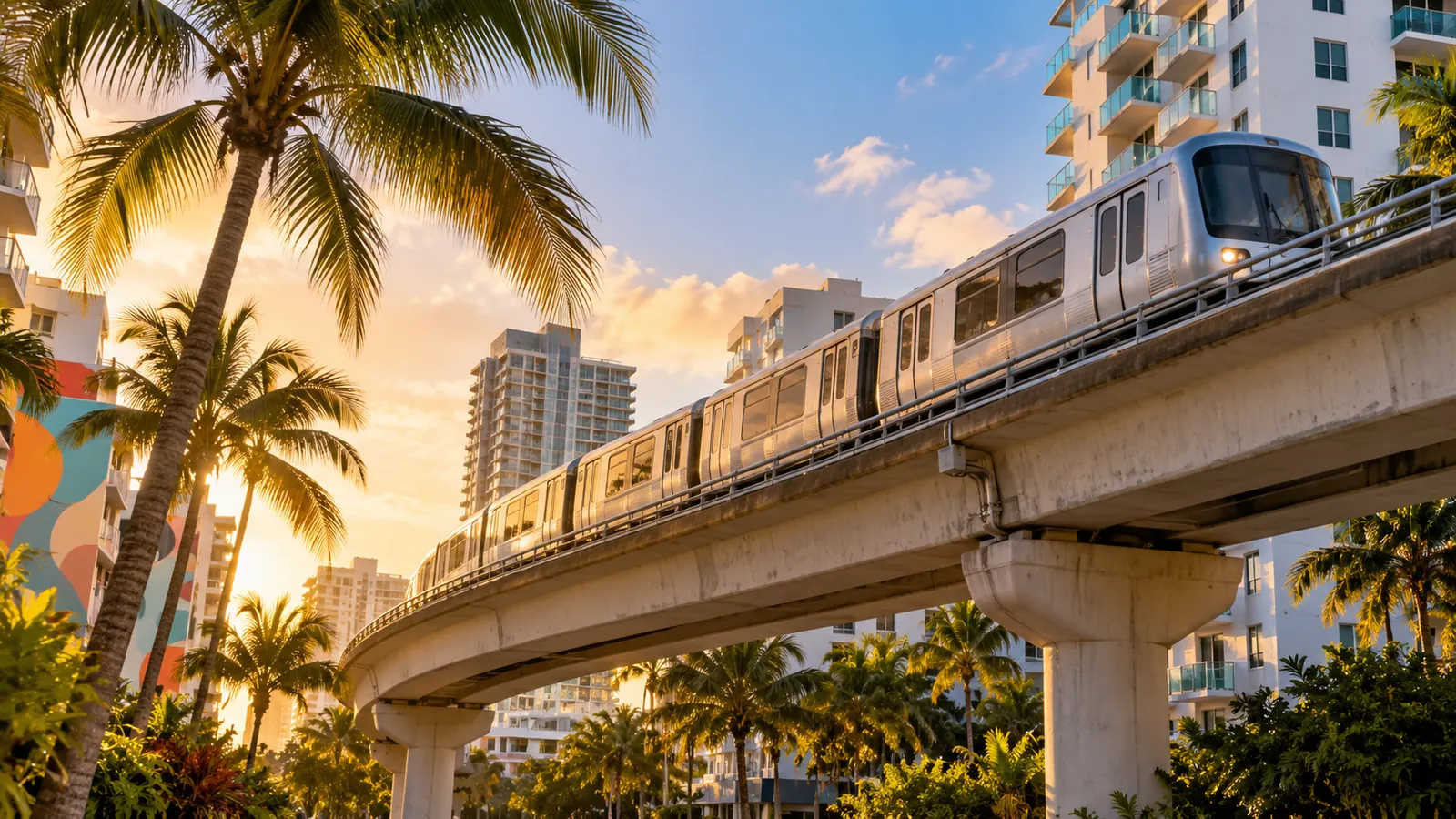
The pieces at a glance
| Service | Run by | Fare | Where it goes |
|---|---|---|---|
| Metrorail | Miami-Dade County | $2.25 | 25 miles, Kendall to downtown, the airport and northwest Miami-Dade |
| Metromover | Miami-Dade County | Free | 21 stations in Brickell, downtown and Omni |
| Metrobus | Miami-Dade County | $2.25 | Countywide routes |
| Miami Trolley | City of Miami | Free | Neighborhood routes inside the city, not Miami Beach |
| Coral Gables Trolley | City of Coral Gables | Free | Ponce de Leon and Grand Avenue routes |
| Miami Beach Trolley | City of Miami Beach | Free | Citywide routes on the beach |
Metrorail: the spine
Metrorail is a 25-mile, two-track line. The county describes it running from Kendall through South Miami, Coral Gables and downtown Miami to the Civic Center and hospital district, then on to Brownsville, Liberty City, Hialeah and Medley. Trains run from 5 a.m. to midnight, seven days a week.
There are two lines. The Green Line runs the full length from Palmetto in the north to Dadeland South. On weekdays the Orange Line takes riders north to the Miami International Airport station. On weekends the Orange Line becomes an airport shuttle between Earlington Heights and the airport every 15 minutes, so you change trains at Earlington Heights. Metrorail also connects to Brightline at the Historic Overtown/Lyric Theatre station and to Tri-Rail, which reaches Broward and Palm Beach counties.
Paying
A ride costs $2.25, or $1.10 for riders who qualify for the discount fare. Fare gates do not take cash. You can tap a contactless bank card or phone, use an EASY Card or EASY Ticket, or buy a pass in the county’s transit app.
- Fare cap: if you tap the same contactless card or EASY Card all day, you will not pay more than $5.65, the price of a 1-Day Pass, for unlimited Metrorail and Metrobus rides.
- Bus-to-rail and rail-to-bus transfers are free with an EASY Card or EASY Ticket.
- County residents whose annual income is below $20,385 may qualify to ride Metrobus and Metrorail free with a Mobility EASY Card.
Metromover: free and frequent
Metromover is the easiest part of the system to love. It is a free elevated people mover, and it serves 21 stations between the Financial District station in Brickell and the School Board station in the Omni area. The system is split into three loops: Brickell, Inner (downtown) and Omni. Cars arrive about every 90 seconds at rush hour and every three minutes at other times, according to the county.
If you work downtown or in Brickell, living near a Metromover station can replace a car for daily errands. The county has been upgrading the system, so check service alerts for weekend closures before you rely on it for a fixed appointment.
The free trolleys
City of Miami
The City of Miami runs free trolley routes through many neighborhoods, including Brickell, Biscayne, Coconut Grove, Coral Way, Little Havana, Little Haiti, Wynwood, Allapattah and the health district. Trolleys arrive roughly every 15 to 45 minutes. Most routes run Monday through Saturday from 6:30 a.m. to 11 p.m., and several also run on Sundays from 8 a.m. to 8 p.m. The Wynwood and Coconut Grove routes list no Sunday hours. One point catches newcomers out: the city trolley does not go to Miami Beach.
Coral Gables
Coral Gables has run its own free trolley since 2003, and the city says it carries more than a million passengers a year. It operates Monday through Saturday from 6:30 a.m. to 10 p.m. on two main routes, Ponce de Leon and Grand Avenue, both starting from the Douglas Road Metrorail station. A Southern Loop pilot route started on November 3, 2025, linking the same station with the University of Miami area. The Gables trolley does not run on Sundays or on the Fourth of July, Thanksgiving and Christmas.
Miami Beach
Miami Beach’s citywide trolley is also free. It runs 15 hours a day, 8 a.m. to 11 p.m., seven days a week, with buses about every 20 minutes on each route. In South Beach the route runs as two loops in opposite directions.
Which neighborhoods work best car-free
Brickell and downtown are the obvious choices: Metromover, Metrorail and several trolley routes overlap there, as Living in Brickell: Towers, Transit and an Ancient Hammock and Living in Downtown Miami: The Free Metromover and a Century of History explain. Edgewater has the Omni loop and trolley stops. Coral Gables and Coconut Grove sit on Metrorail and have their own trolley routes. Miami Beach is easier inside the island than to and from the mainland.
Tip: Before signing a lease, do the trip to work at rush hour once, with the transit app open. A route that looks simple on a map can involve a long wait for a single connection.
Bikes
Bikes are allowed inside Metrorail cars, and every Metrorail station has bike racks. Free covered bike lockers, which you secure with your own padlock, are available first come, first served at Metrorail stations and other sites. Combining a bike with rail can cover the gap between a station and your front door.