
On the back of the card
- Metromover’s Inner Loop circles downtown, and the system is free; cars come about every 90 seconds at rush hour.
- The Freedom Tower at 600 Biscayne Boulevard opened in 1925 and was designated a National Historic Landmark on October 6, 2008.
- Downtown includes the Downtown National Register District, one of the historic districts managed by the City of Miami’s preservation office.
Downtown Miami runs from the Miami River north along Biscayne Boulevard, with the bay on one side and the county government center on the other. For a long time it emptied out at night. Today more people live here, in new towers and in older buildings, and it is the hub of the region’s transit. If you want to be at the center of things and close to the waterfront, it is worth a serious look.
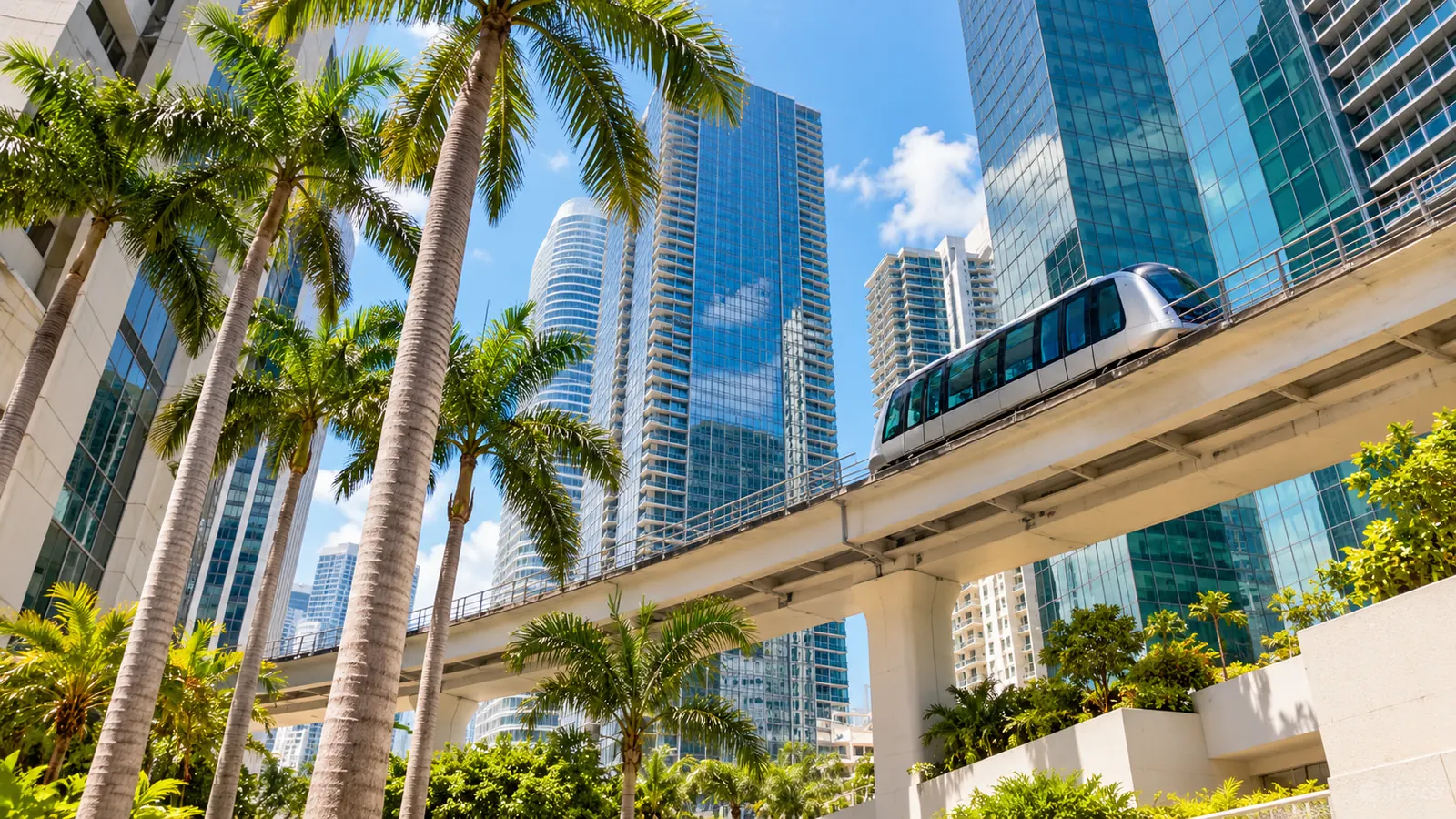
Transit: the best in the county
Downtown is where Miami’s transit comes together. Metromover’s Inner Loop circles the core, and the Brickell and Omni loops branch off it, so you can ride free in three directions. Metrorail stops at Government Center and other downtown stations, putting Coral Gables, Dadeland and the airport within one trip. Brightline connects at the Historic Overtown/Lyric Theatre Metrorail station, and Tri-Rail can be reached by Metrorail.
The City of Miami’s free Biscayne trolley serves downtown, Brickell and the Biscayne corridor, with a stop at Bayfront Park. It runs Monday through Saturday from 6:30 a.m. to 11 p.m. and on Sundays from 8 a.m. to 8 p.m. Put together, these services mean many downtown residents use a car only for trips out of the core. Fares and passes are explained in Getting Around Miami Without a Car: Metrorail, Metromover and the Free Trolleys.
The Freedom Tower
The landmark that defines downtown’s skyline for many Miamians is the Freedom Tower at 600 Biscayne Boulevard. According to the National Park Service, construction began on June 11, 1924, and the building opened on July 26, 1925, as the headquarters and printing plant of a daily newspaper. Its design was based on the Giralda tower of the Cathedral of Seville.
The building took its present name in the 1960s. From 1962 through 1974 it housed the federal Cuban Assistance Center, where refugees from Cuba were processed and received medical care, food and financial help. The Park Service calls it the “Ellis Island of the South.” It was listed in the National Register of Historic Places in 1979 and designated a National Historic Landmark on October 6, 2008. Today it belongs to Miami Dade College, and admission to its second-floor exhibition space is free. The story continues in Living in Little Havana: Calle Ocho, Domino Park and the Cuban Story.
A district with protected buildings
The City of Miami’s historic preservation office manages the Downtown National Register District, along with more than 100 designated individual sites across the city and 10 local districts. The city names the Freedom Tower and the Olympia Theater among its high-style landmarks. If you are considering a loft or condo in an older downtown building, ask whether it is designated. Exterior changes to designated properties go through the city’s certificate of appropriateness process.
The waterfront
Bayfront Park, at 301 Biscayne Boulevard, is downtown’s front yard on the bay and a stop on the Biscayne trolley. A short walk away, the Miami River marks the line with Brickell; the Tequesta village that once stood at the river mouth is described in Living in Brickell: Towers, Transit and an Ancient Hammock. North of downtown, Margaret Pace Park in Edgewater gives residents another green space on the water.
What daily life involves
- Groceries and errands: plan around the Metromover loops rather than a car trip.
- Noise: ask whether the building faces an event venue or a busy boulevard, and visit on a weekend night.
- Parking: if you keep a car, budget for a garage space, which many buildings charge for separately.
- Heat: July and August average about 24 days a year at 90 degrees or warmer, so a walk between stations is best kept short at midday.
Storms and water
Downtown lies along the bay and the river, so check the storm surge planning zone of any building. Miami-Dade uses five zones, A through E, and orders evacuations by zone based on the forecast surge. Ask the building management about generator power for elevators and water pumps, hurricane shutters or impact glass, and where cars go during a storm.
Buyers of a condo should read the seller’s Florida flood disclosure, required at or before contract signing, and price flood insurance separately from the condo policy. Renters can ask the same questions directly: has the building flooded, and has the garage?
Tip: Visit on a weekday morning and again on a weekend evening. Downtown’s daytime office crowd and its event nights feel like two different neighborhoods.
Who it suits
Downtown suits people who want to walk to work, ride transit everywhere and live near the bay, and who enjoy a city center that is still changing. If you want trees, a porch and a quieter street, look at Coconut Grove or Coral Gables instead; if you want a slightly calmer version of tower living, read Living in Edgewater: Bayfront Towers North of Downtown.