
On the back of the card
- The Miami Beach Art Deco Historic District was listed in the National Register of Historic Places on May 14, 1979, the first district made up mainly of 20th-century buildings to be listed.
- Miami Beach’s free citywide trolley runs 8 a.m. to 11 p.m., seven days a week, about every 20 minutes on each route.
- The City of Miami trolley does not go to Miami Beach; the two cities run separate systems.
Miami Beach is not a neighborhood of Miami but its own city, on a long barrier island between Biscayne Bay and the Atlantic. Causeways tie it to the mainland. Living there means beach and ocean at the end of the street, pastel buildings and a constant flow of visitors. It also means living with the island’s exposure to storms.
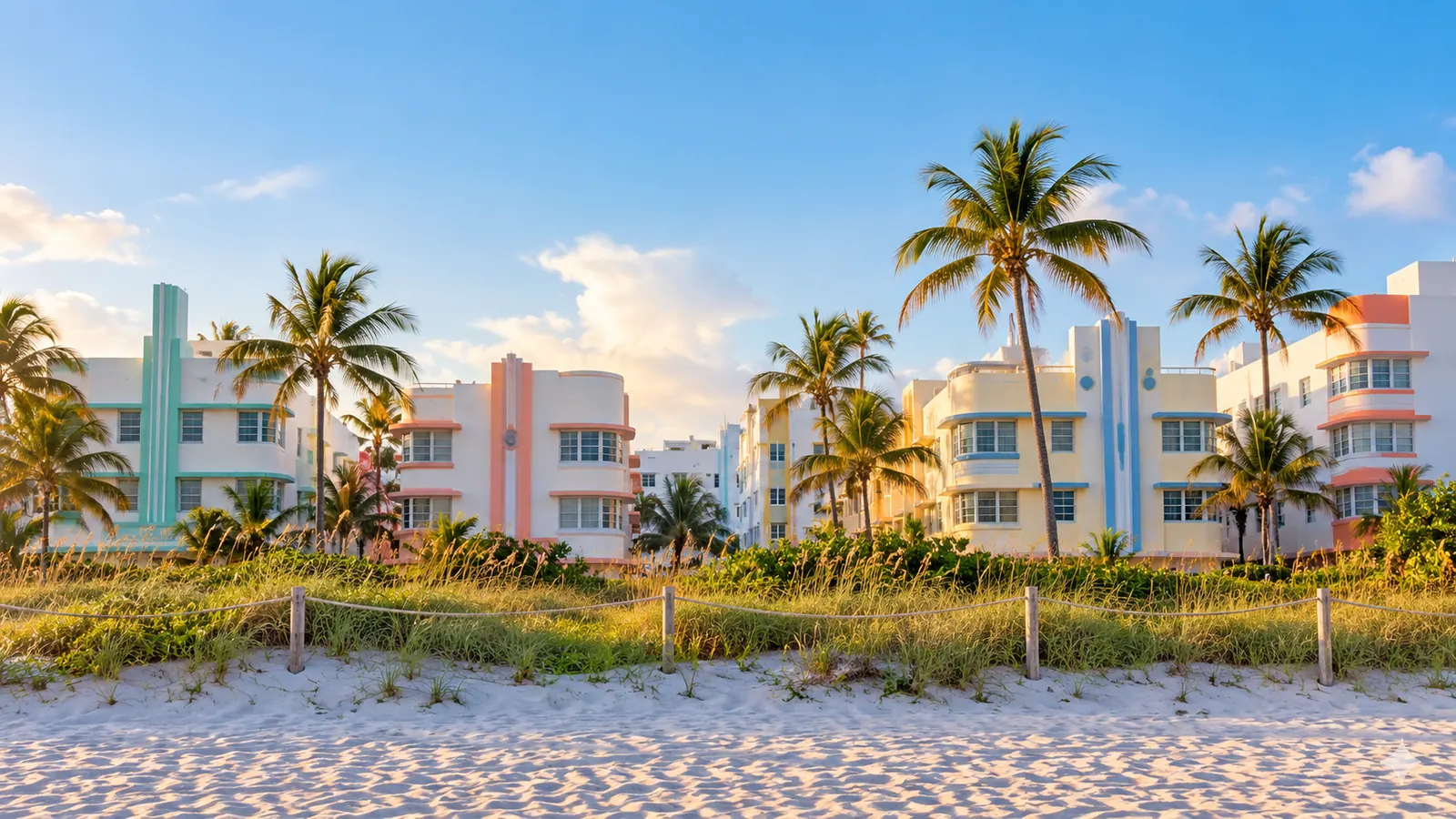
The Art Deco district
The best-known part of the city is its Art Deco district in South Beach. According to the City of Miami Beach, the district was listed in the National Register of Historic Places on May 14, 1979. It was the first district made up mainly of 20th-century architecture, largely built in the 1930s and 1940s, to receive that recognition.
The city describes the style through pastel colors, porthole windows and sleek geometric lines. The designation helped save many buildings from demolition, and as they were restored, the district drew investment and tourism. The city notes, with some humor, that these buildings were once considered too new to be historic.
For residents, living in a historic building means charm and limits. Ask about room sizes, the air conditioning and the age of the plumbing, and remember that exterior changes go through the city’s preservation review. Settle these questions before you sign a lease or contract.
A tourist economy at your door
Miami Beach’s own figures show the scale of the visitor trade: in 2023 Greater Miami and Miami Beach welcomed more than 27.2 million visitors, who spent an estimated $21.1 billion. That supports jobs and businesses, and it also shapes daily life. Expect busy streets near the beach and the entertainment corridors, and ask early about parking. Blocks a little away from the busiest streets can mean quieter evenings.
Tip: If you are viewing an apartment in South Beach, come back on a weekend night. The same street can feel very different after dark.
Getting around
Miami Beach runs a free citywide trolley. According to the city, service runs every day of the week for 15 hours, from 8 a.m. until 11 p.m., and a trolley comes along roughly every 20 minutes on each route. In South Beach the route runs as two loops in opposite directions, launched in November 2017 to replace older county and city shuttle routes. Low-floor vehicles make boarding easier with strollers or wheelchairs.
One detail matters for commuters: the City of Miami’s free trolley does not cross to Miami Beach. Trips to downtown or Brickell mean a county bus over the causeways, a car or a bike. For an overview of the mainland network, see Getting Around Miami Without a Car: Metrorail, Metromover and the Free Trolleys.
Storms and water on a barrier island
Island living has obvious appeal and obvious exposure. Miami-Dade County’s storm surge planning zones, A through E, mark areas that could see a surge of a foot and a half or more, and evacuations are ordered zone by zone based on the forecast surge. Check the zone for any address before you commit, and learn the evacuation routes over the causeways.
The Atlantic hurricane season runs from June 1 to November 30, peaking around September 10, according to the National Hurricane Center. Miami’s rainiest months on average are June and September, each with more than 10 inches at the airport.
- Buyers: the seller must give you Florida’s flood disclosure at or before contract signing.
- Flood insurance is separate from homeowners and condo policies; get a quote early.
- Renters: ask whether the building, its lobby or its garage has flooded, and whether the landlord installs shutters before a storm.
- Condo buyers: ask the association about recent and planned work on the building and how it is paid for.
The calm season is winter. Federal climate normals for Miami International Airport give average January highs around 76 degrees and lows around 61, with less than 2 inches of rain for the month. For many residents those are the most comfortable beach months.
Owning a home
The Florida homestead exemption applies on Miami Beach as anywhere in the state. If you own the home and live there permanently on January 1, apply to the Miami-Dade Property Appraiser by March 1. The exemption can reduce taxable value by about $50,000, and the Save Our Homes cap then limits yearly increases in assessed value to 3 percent or inflation, whichever is lower. Owners who rent out their units do not get the exemption.
Who it suits
Miami Beach suits people who want the ocean on their doorstep, enjoy historic architecture and a lively street scene, and are ready to plan for storms. It suits less well if you commute daily to the mainland without a car. For a quieter island village south of Miami, see Living in Key Biscayne: An Island Village Between Two Parks.